About Bangalore Office
Empathetic Legal Solutions in Bangalore

Fairaigle Legal & Consultancy LLP is proud to extend its comprehensive litigation, business, and forensic advisory services to Bangalore. Located at Workfella Infantry Road, our new office is dedicated to serving clients across Karnataka with local expertise and a client-first approach.

  • Convenient Infantry Road location for face-to-face consultation.

  • Dedicated local support backed by our national legal team.

Message from the founder
Welcome to Fairaigle Bangalore Branch

ADV. ANINDITA PAL

Founder & Managing Partner, Fairaigle Legal & Consultancy LLP

As the Founder & Managing Partner of Fairaigle Legal & Consultancy LLP, I am delighted to welcome you to our Bangalore branch. Our expansion into Bangalore represents a significant milestone in our mission to deliver empathetic, high-quality, and result-oriented legal advisory services across India.

With over 14 years of litigation experience, my goal is to ensure that our Bangalore clients receive the highest standards of professional representation, integrating business strategy and forensic analysis to resolve complex legal disputes.

Whether you are a startup needing corporate advisory, or an individual seeking family mediation, our Bangalore office is equipped to provide tailored legal support. We look forward to building strong relationships and serving the local community with integrity.

Professional Philosophy

"Justice is best served when legal expertise is combined with integrity, innovation, and a deep understanding of human realities."

Founder & Managing Partner
Adv. Anindita Pal
Core Areas of Practice
  • Matrimonial & Family Law
  • Criminal Litigation
  • Corporate & Commercial Law
  • Cybercrime & Digital Evidence
  • Property & Real Estate Disputes
  • Consumer Protection Cases
  • Debt Recovery & Banking
  • Contract Drafting & Documentation
  • Legal Compliance & Advisory
  • Forensic Consultation & Support
Professional Qualifications
  • Advocate
  • MBA (Entrepreneurship)
  • Master's in Forensic Science & Criminology
Why Choose Us
Why Choose Us

At Fairaigle Legal Consultancy, we combine experience, strategic thinking, and client-focused legal services to deliver trusted legal solutions. Our Bangalore office brings compassionate support, expert guidance, and results-oriented representation closer to you.

Discover more
Watch Fairaigle
Fairaigle Promo Video
Bangalore Operations
Infantry Road Office

Our central co-working office space at Workfella Infantry Road provides startups and business owners with direct access to physical legal consultation.

Karnataka Legal Tech

We are actively engaging with Karnataka's startup community to deliver next-generation legal compliance, advisory, and documentation support.

Legal Services in Bangalore
Professional Legal Services We Offer

Fairaigle Legal Consultancy provides trusted legal services in Bangalore, specializing in documentation, review, evidence handling, and structured case support for individuals and businesses.

Discover more
Qualified experts
Meet Our Attorneys

Senior Partner serving Bangalore

No senior partners available.

Senior Attorneys serving Bangalore

Junior Attorneys & Associates serving Bangalore

Trusted by Clients Across Bangalore
What Our Clients Say About Our Legal Services
Latest Blogs
Updated Latest Blogs

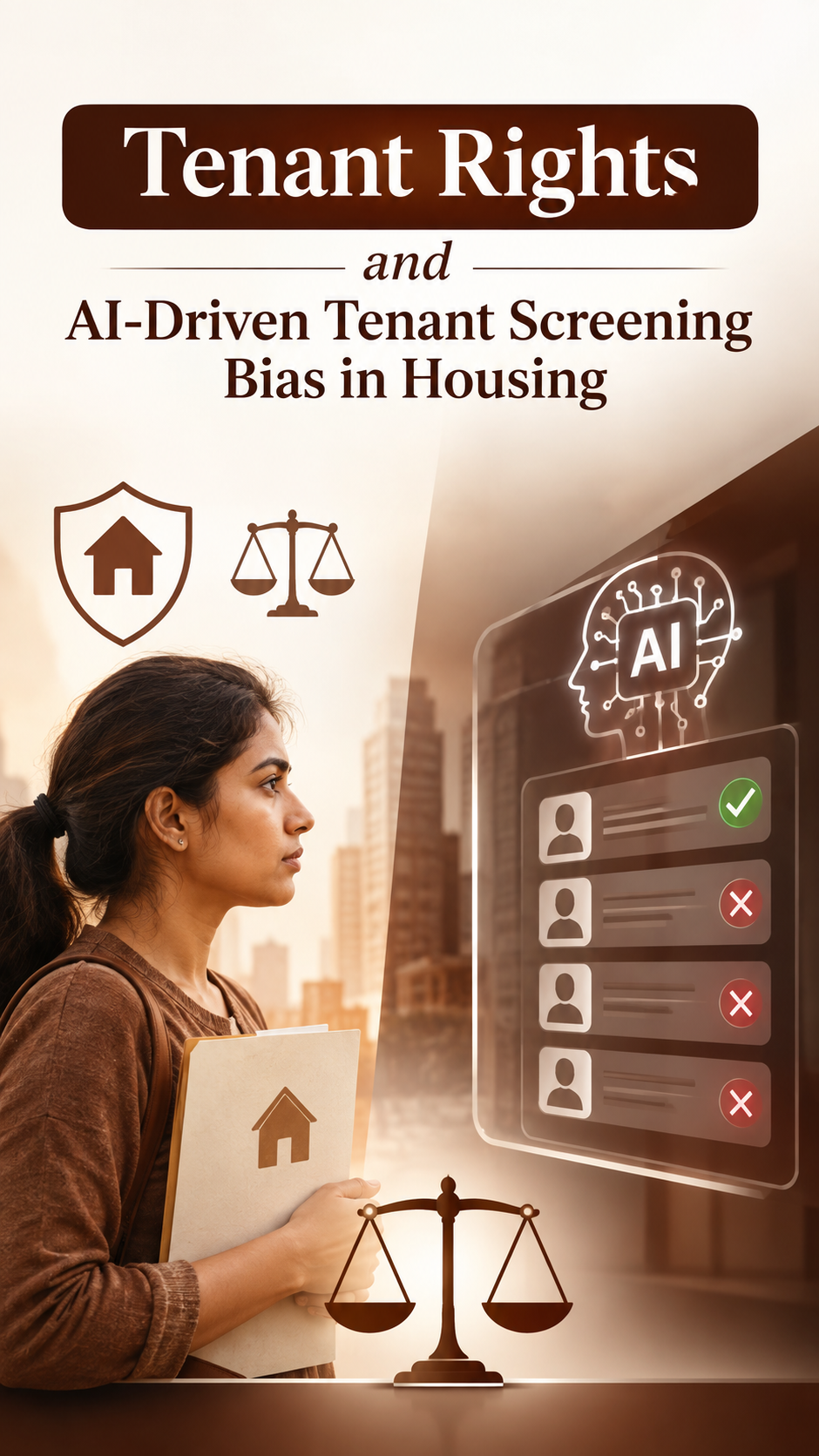
Denied by AI: Know Your Rights Against Screening Bias

Ever Been Rejected for an Apartment and Never Found Out Why?You filled out the application. You paid the fee. You waited. Then came the denial email vague, cold, and final. No explanation. Just "does not meet our screening criteria." Here's what most renters don't realize: a human probably never looked at your file. A piece of software did. And that software may have used flawed data, outdated records, or factors that have nothing to do with whether you'd actually be a good tenant. Landlords across the country now lean on automated tenant screening platforms to check credit, criminal history, and eviction records in seconds. It's fast, it's cheap, and it feels "objective." But objective isn't the same as fair and a growing pile of lawsuits, settlements, and new state laws says these tools can quietly discriminate against the very people the Fair Housing Act was built to protect. How AI Tenant Screening Actually Works Most screening platforms pull data from credit bureaus, court records, and eviction databases, then run it through a scoring model. The model spits out a number or a color-coded "recommendation" approve, deny, or flag for review. The problem is what happens inside that black box. These systems often use proxy variables things like zip code, name patterns, or rental history gaps that correlate with race, national origin, or disability status even though they're never labeled that way. The algorithm isn't told to discriminate. It just learns patterns from historical data that already reflects decades of housing inequality, and then repeats them at scale. Eviction records are a classic example. Filing an eviction case is easy and cheap for landlords, even when the case is later dismissed or the tenant wins. Many screening tools count the filing itself, not the outcome. That quietly penalizes tenants disproportionately women, people of color, and domestic violence survivors for eviction cases they never lost. The Legal Risk Landlords Aren't Watching The Fair Housing Act doesn't just ban obvious, intentional discrimination. It also bans policies that look neutral on paper but fall harder on a protected group a legal theory called "disparate impact." That means a landlord can lose a fair housing case even if no human ever intended to discriminate. If the algorithm's output has that effect, the landlord is on the hook, because courts have made clear that outsourcing a decision to a vendor doesn't outsource the liability. That's exactly what played out in one of the most closely watched cases in this space. In Louis v. SafeRent Solutions, renters including a Black woman named Mary Louis sued a major screening company, arguing its scoring algorithm downgraded applicants using housing vouchers and disproportionately hurt Black and Hispanic renters. A federal court in Massachusetts approved a settlement worth about $2.275 million, and SafeRent agreed to stop issuing "approve" or "decline" recommendations for voucher holders unless the model is independently validated for fairness. SafeRent didn't admit fault, but said continuing to litigate would cost more than settling. It's one of the first cases of its kind, and it sent a clear signal: "the algorithm did it" is not a defense. Regulators haven't stayed quiet either. The Federal Trade Commission and Consumer Financial Protection Bureau previously extracted $15 million from a major screening company over inaccurate background reports, and states are now moving faster than Washington. Colorado's AI Act treats tenant screening systems as "high-risk," requiring fairness testing, consumer disclosures, and human review before decisions go out. New York lawmakers have proposed rules forcing landlords to plainly disclose when AI is involved in a rental decision and to explain, in plain language, exactly what criteria were used. Meanwhile, federal guidance on this topic has been pulled back and reinstated more than once which means the safest legal ground right now isn't waiting on Washington, it's following your state and city rules and the underlying statute itself. What Renters Can Do If They Get DeniedYou have more leverage than you think:Request the actual report. Under the Fair Credit Reporting Act, you're entitled to a free copy of any screening report used to deny you, along with the name of the company that generated it.Ask for the specific reason. A landlord can't just say "didn't pass screening." You're entitled to know which factor triggered the denial.Dispute errors directly with the screening company. Mixed-up identities, resolved eviction filings, and outdated criminal records are common and correctable.File a complaint with HUD, your state fair housing agency, or a local tenant rights organization if you believe the denial reflects a pattern tied to race, disability, source of income, or another protected class.Talk to a fair housing attorney before you assume the denial is final. Many consultations are free, and disparate impact claims often hinge on data patterns a lawyer can help uncover.What Landlords Can Do to Avoid a LawsuitIf you manage rental property, a few habits go a long way:Vet your vendor. Ask screening companies how their model was tested for bias and whether it's been independently audited.Build in human review. Never let a score alone trigger an automatic denial, especially for borderline cases or voucher holders.Distinguish filings from outcomes. Don't penalize applicants for eviction cases that were dismissed or resolved in their favor.Document everything. If you deny someone, keep a written record of the specific, individualized reason not just "algorithm flagged."Watch your state law, not just federal guidance, since states like Colorado and New York are moving faster than Congress.FAQsIs it legal for a landlord to use AI to screen tenants?Yes, but the decision the AI produces still has to comply with the Fair Housing Act and local tenant screening laws. Legal to use, not automatically legal in outcome.Can I sue a landlord for a discriminatory algorithm? Yes. Disparate impact claims under the Fair Housing Act don't require proof of intent only that a policy or tool produced a discriminatory effect on a protected class.Does the screening company or the landlord get sued? Often both. Recent cases have named the software vendor directly, but landlords remain independently responsible for the decisions made using that software.What if I was denied because of an old eviction filing that was dismissed? Ask for a free copy of your report and dispute it. A dismissed filing shouldn't count against you, and many jurisdictions now limit how far back these records can be reported.Are housing voucher holders protected from AI scoring?Increasingly, yes. Recent settlements and several state laws specifically restrict automated scoring for applicants using housing assistance.ConclusionAI tenant screening isn't going away it's getting more common, not less. But "the computer said no" has never been a legal shield, and courts and regulators are making that clearer every year. Whether you're a renter who just got a confusing denial or a property owner trying to stay compliant, the algorithm doesn't get the final word. The law does.If you've been denied housing and suspect bias, or you're a landlord looking to audit your screening process before it becomes a lawsuit, reach out to our fair housing team for a consultation.Book your consultation today

SRA Disputes in Mumbai: Why Your Slum Redevelopment Case Might Be Stuck

You signed the papers. You waited for your new flat. Ten years later, you're still waiting — or worse, you're being asked to vacate a home you've lived in for decades. If this sounds familiar, you're not alone. Thousands of Mumbai families are caught in Slum Rehabilitation Authority (SRA) disputes right now, and most don't know what rights they actually have. This isn't a niche legal issue. It's a daily reality for slum dwellers, developers, housing societies, and even law students trying to make sense of one of India's most litigated urban policy frameworks. Let's break it down in plain language. What Exactly Is the SRA, and Why Do Disputes Happen? The Slum Rehabilitation Authority was set up under the Maharashtra Slum Areas (Improvement, Clearance and Redevelopment) Act, 1971, to convert slums into proper housing. In theory, it's simple: a developer builds free flats for slum dwellers in exchange for extra construction rights (FSI) they can sell.In practice, it gets messy fast. Common flashpoints include:Eligibility fights — who counts as a genuine slum dweller versus a later encroacherTransit rent non-payment — developers stop paying rent to displaced families mid-projectStalled projects — construction halts for years due to funding or approval issuesAnnexure-II disputes — disagreements over the official list of eligible beneficiariesDeveloper-society conflicts — private settlements that clash with SRA's own rules Each of these can trap a family in limbo for years, and often the only way out has been to knock on the Bombay High Court's door. New Law Update: The "Special Cells" Order That Changes EverythingHere's the big one. On 23 December 2025, the Bombay High Court delivered a major ruling in Om Shri Sai SRA Co-operative Housing Society v. State of Maharashtra & Ors., disposing of over 60 pending writ petitions in one go. What did the Court actually do? Instead of letting each case drag through years of litigation, it directed newly formed Special Cells within the SRA to promptly and effectively address grievances relating to non-payment of transit rent by developers and eligibility disputes.Two things stand out for everyday citizens:These Special Cells aren't courts. The Court clarified they are not independent adjudicatory bodies but forums for amicable, mediation-style dispute resolution the idea being a quick settlement rather than adversarial litigation. Financial protection is built in. To stop developers from defaulting on rent again, the Court directed SRA to freeze a portion of the developer's free-sale component specifically the lower floors as security until the rehab building is finished and transit rent dues are cleared.What this means for you: if you're a slum dweller waiting on unpaid rent or disputed eligibility, you now have a faster, less intimidating first stop before heading to court. And if the Special Cell doesn't resolve it, you can still approach the statutory forums afterward nothing is taken away from you. Policy Shift: "Majhe Ghar, Majha Adhikar"Beyond court rulings, the state government itself is rewriting the rulebook. Under the "Majhe Ghar, Majha Adhikar" policy launched in May 2025, the state moved away from piecemeal single-slum projects toward redeveloping entire wards at once, rehabilitating multiple slum clusters through integrated planning meaning better roads and parks instead of isolated towers in still-crowded areas.Another practical change: areas like parking, staircases, lifts, and lobbies are now included in FSI calculations, which pushes builders toward constructing higher-quality buildings with real amenities instead of cutting corners on saleable area. Central government land can now also be pooled into joint ventures for rehabilitation projects, opening up more sites beyond crowded private plots. If you're negotiating with a developer or checking a project's status, it's worth verifying against these updated rules the ground has shifted since 2025. Case Law Breakdown: Can a Private Deal Override the SRA?Here's a ruling every tenant, society member, and developer should understand. The Supreme Court held that private agreements within Slum Rehabilitation Schemes cannot be enforced if they go against the SRA's own statutory directives, reinforcing that the SRA alone has authority over how the scheme is implemented under the 1971 Slum Act. The backstory: a housing society had a settlement with a developer over how flats would be allotted. But when it came time to allot units, the SRA instead followed its own circular requiring a draw of lots among hutment dwellers, rather than the terms of the earlier private agreement. The society challenged this and lost, all the way up to the Supreme Court.The Court's core reasoning, in plain words: no private MoU, however well-intentioned, can tie the SRA's hands. Bombay High Court's earlier ruling in the Usha Dhondiram Khairnar case had already established that neither slum societies nor private developers get to dictate terms to the SRA the authority must simply follow its own established policies and circulars. Why it matters: if you've signed a side agreement with a developer that promises something outside SRA's official process, don't assume it's enforceable. Get it formally routed through SRA's own procedures, or it may not hold up.FAQs1. My developer stopped paying transit rent. What can I do? Approach the SRA's Special Cell first for a quicker resolution. If unresolved, you can still move the Bombay High Court or the relevant statutory forum.2. Can the SRA remove a developer from a stalled project? Yes. Courts have upheld SRA's power to reassign a stalled project to another developer under Section 13(2) of the Slum Act when there's contravention of approved plans or long, unexplained delays.3. What if I'm not on the eligibility list (Annexure-II)? You can raise this with the SRA CEO's committee, which now includes nominees from MHADA and the Municipal Corporation specifically for resolving these disputes.4. Can litigation stall a redevelopment project indefinitely? Not easily. Courts have made clear that a person who sits on their rights for years cannot suddenly challenge a project just to delay it timely objections matter.5. Is a private settlement with my developer legally binding? Only if it aligns with SRA's own policies and circulars. If it conflicts with SRA's rules, it won't be enforced, regardless of what was agreed privately.6. Who do I contact for updates on my SRA project? Track it directly through the official SRA portal, since implementation rules are still evolving under the new ward-based redevelopment policy.ConclusionSRA disputes aren't just paperwork problems they affect where families sleep at night and how developers plan crores in investment. The good news is the legal and policy landscape is actively shifting toward faster resolution: mediation-first Special Cells, financial safeguards against defaulting developers, and clearer rules on what private deals can and can't override. If you're stuck in a dispute, don't wait it out silently. Check whether a Special Cell exists for your project, verify your Annexure-II status, and if things still don't move, the Bombay High Court remains open to you.

Can a Business Deal Gone Wrong Land You in Jail? Delhi High Court Says No

You signed a contract. The other side didn't deliver. You're angry, you've lost money, and someone tells you: "Just file an FIR, that'll scare them into paying up."Stop right there. The Delhi High Court has been saying, loudly and repeatedly, that this shortcut is illegal. A broken business promise is not automatically a crime and using the police to collect a commercial debt can get your own case thrown out of court. If you run a business, sign vendor contracts, or are simply curious about how Indian courts are drawing the line between civil wrongs and criminal offences, this one's for you. The Big Trend: Courts Are Done With "FIR as Leverage"For years, a familiar playbook existed in Indian business circles: goods don't arrive, payment bounces, a deal falls apart — and instead of filing a civil recovery suit (which takes time), the aggrieved party rushes to the police station with a cheating or criminal breach of trust complaint. It's faster, it's scarier, and it often pressures the other side into settling. Courts have started shutting this down hard. New Law Update: The Latest Delhi High Court RulingIn a fresh order this month, the Delhi High Court stayed the registration of an FIR in a commercial dispute involving an alleged shortfall in the supply of goods worth over ₹1.75 crore. The magistrate below had directed the police to register a case, but the High Court found the order legally shaky it didn't even clearly spell out what criminal offence had actually been committed. The judge leaned on a well-known Supreme Court precedent, Indian Oil Corporation v. NEPC India Ltd. (2006), which had already warned against the "growing tendency in business circles" to convert ordinary civil disputes into criminal prosecutions as a pressure tactic. The Delhi High Court called the practice something that deserves to be actively discouraged, not encouraged by lower courts mechanically ordering FIRs. Case Law Breakdown: The ₹8.38 Crore Real Estate DisputeHere's a simpler example that shows exactly how this plays out. A group of investors had signed an MoU with a real estate developer for commercial development rights and flat allotments. When the project didn't go as promised, the investors accused the developer of fraud and cheating, and pushed for an FIR under multiple IPC sections.The Delhi High Court refused. Justice Neena Bansal Krishna held that not every broken promise is cheating for a criminal case to stick, there has to be proof that the person never intended to honour the deal right from the start. In this case, the court found the real story was a failed business arrangement, not a scam. The flats weren't delivered as expected, yes but that's a contract problem to be fought out in a civil court, not a police station. The court's core reasoning, in plain English: disappointment with a business outcome isn't the same as being cheated. Intent to deceive has to exist at the time the deal was made not just be assumed after things go wrong. The Important Exception Nobody Talks AboutThis isn't a blanket rule that FIRs can never follow a contract dispute. In 2025, the Supreme Court actually revived an FIR that the Delhi High Court had quashed, clarifying that simply having a parallel civil case doesn't automatically mean the criminal complaint is baseless. If there's genuine prima facie evidence of forgery, fabrication, or fraud, the criminal process can still run alongside a civil claim. Takeaway: courts look at facts, not labels. Calling something "cheating" doesn't make it cheating. But real evidence of fraud isn't erased just because a contract also exists.What This Actually Means for YouIf you're a business owner or vendor: don't assume an FIR is your fast lane to recovering dues. If the dispute is genuinely about delayed delivery, quality issues, or payment default with no proof of dishonest intent from day one, criminal courts likely aren't the right forum and you could face costs for misusing the process.If an FIR has been filed against you over what looks like an ordinary business disagreement, you may have strong grounds to approach the High Court under Section 482 CrPC (or its BNSS equivalent) to get it quashed.If you're a corporate legal team: document intent-related communications carefully. Emails, WhatsApp chats, and payment timelines that show good-faith effort matter enormously if a criminal complaint is later filed against your company.Frequently Asked QuestionsQ: Can I file an FIR just because someone didn't pay me as agreed? Not automatically. Non-payment alone is usually a civil breach. You'd need to show dishonest intent existing at the time the contract was made.Q: What's the difference between "cheating" and "breach of contract"? Breach of contract is simply failing to keep a promise. Cheating requires proof that the person never intended to keep that promise in the first place.Q: I already filed a civil suit can I still pursue a criminal case for the same dispute? Yes, in principle, if there's independent evidence of fraud. But courts will scrutinise whether the criminal complaint is genuine or just a pressure tactic.Q: My FIR was quashed does that mean I lose my money? No. Quashing an FIR doesn't affect your right to recover dues through a civil suit or arbitration; it only removes the criminal angle.Q: What about property or employment disputes same rule? Broadly yes. Courts apply similar logic in property disagreements (e.g., builder-buyer disputes) and employment contract breaches: the wrong needs criminal ingredients, not just a broken promise, to justify police action.Q: Where can I read the actual judgments? You can check official orders on the Delhi High Court website and track Supreme Court judgments via main.sci.gov.in.The message from the Delhi High Court is consistent: contracts belong in civil court, crimes belong in criminal court, and mixing the two to gain leverage will backfire. If you're dealing with a business dispute, get proper legal advice before choosing your battlefield it could save you time, money, and a wasted trip to the police station.Book your consultation today

Social Media
Updated Latest Social Media
LinkedIn
Updated Latest LinkedIn
All people are equal before the law. A good attorney in Bangalore is what makes a difference.

Get in touch

9989347206
WhatsApp